How To Choose Diamond Stud Earrings
Diamond beauty versus cost: What is the best combination? Better quality diamonds are more brilliant and beautiful, but they command higher prices as well. This article explains how to find the best value in diamond stud earrings: the brightest diamond for the lowest cost.
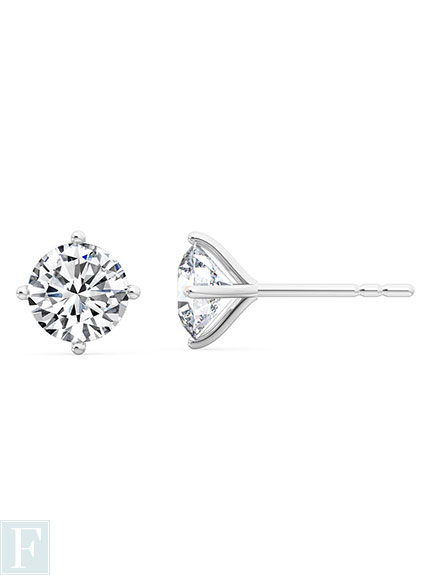
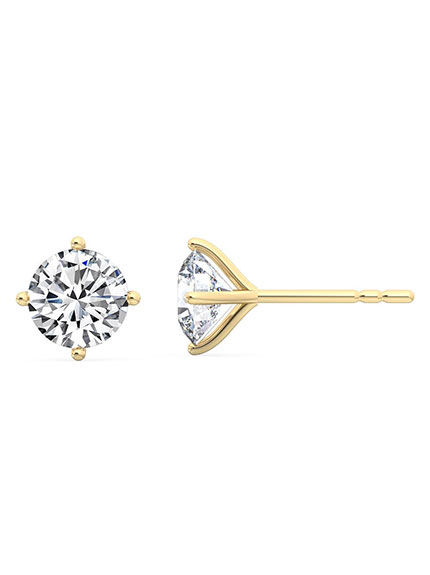
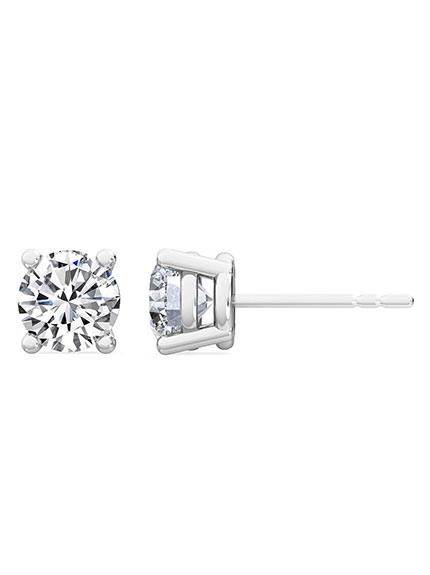
For those who can afford it, we recommend an excellent cut diamond of G-H color and "eye-clean" clarity. This is a moderately priced diamond, but earrings of this quality will produce the same dazzling shower of light as those costing thousands of dollars more.
There are three simple reasons: first, it is the excellent cut that breathes life and sparkle into a diamond. Second, most experts agree that a G-H color appears colorless when mounted, so spending more for D-E-F color diamonds isn't necessary. Third,a diamond of SI2 clarity is "eye-clean", meaning it has no flaws visible to the naked eye, but costs a lot less than the higher clarity grades.
Excellent bargains with only a slight compromise in beauty can be found in the I1 Clarity range as well, as long as the cut is good and the color is in the G-H range.
For those who are on a budget, don't feel embarrassed to buy diamonds of a lower quality. All diamond earrings sparkle when they are worn on a woman's ear, and let's face it: for the same price, many women would rather wear 1 carat studs of a lower quality than 1/2 carat studs of a higher quality.
Choosing the right Color: The finest diamonds are colorless, rare and expensive. On the GIA grading scale, D-F are considered colorless, G-I near colorless and any grade J or below shows an increasingly yellowish tinge. Beyond the preference for a whiter stone, however, the color of a diamond does not affect its brightness or sparkle.
Fast Fact: Most experts agree that, when mounted, diamonds in the "G-H" range appear colorless, and represent a much better value than "D-F" stones which command significantly higher prices.
Choosing the right Clarity: Diamonds with fewer flaws (inclusions) are rare and therefore more highly prized. In many cases, these flaws don't detract from the beauty of the diamond because they are invisible to the naked eye.
Fast Fact: Any grade "SI2" or above has inclusions that are "eye clean", not visible to the naked eye. An "I1" grade can be an excellent value, particularly if the inclusion is on the outer edge. "I2" grades can still exhibit a fair degree of fire and light. "I3" grade diamonds are noticeably more opaque or dark to the naked eye.
Choosing the right Cut: More than any other attribute, it is the Cut that makes a diamond brilliant and beautiful. A diamond that is well cut reflects light internally and displays a dazzling shower of light back through the top of the stone.
Fast Fact: When viewing a diamond, look directly into the center: if there are dark facets in the center or a dark ring around the center, or if the diamond appears opaque, it is probably due to poor cut.
Brilliance, Dispersion and Scintillation: The secret of a diamond that is properly cut is that it returns a measurably greater amount of light, which is displayed as brilliance, dispersion and scintillation. This is the true measure of a diamond's beauty.
Brilliance: The total amount of white light, both external and internal, returned from the diamond to the eye of the observer. Dispersion: Flashes of color, or fire, particularly when viewing a diamond in strong, direct light.
Scintillation: Reflections and flashes of white light from the diamond's surface as the diamond, observer or light source moves.